Good Morning and Welcome!
Carolyn Miller was in our spotlight back in June with a peek into her latest novel, Dusk's Darkest Shores. Today she brings us the story behind the story. Take it away, Carolyn...
While most stories set in Regency England focus on the rich, the young,
and the beautiful, award-winning author Carolyn
Miller decided she wanted to give
readers something different for a change. Her new Regency Wallflowers series follows
the commoners, away from the hustle and bustle of 1810s London, out in the Lake
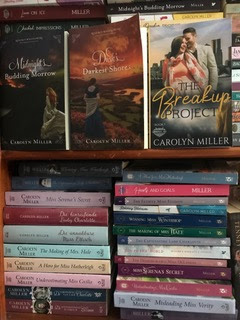
District of England. The new trilogy begins with Dusk’s Darkest Shores (Kregel Publications/May 18,
2021/ISBN: 9780825446535/$15.99), which tells the story of a meek wallflower who finds herself helping a
returning war hero whose dreams have been plunged into darkness.
Q: Please introduce us to
your new Regency Wallflowers series, and specifically to your latest release, Dusk’s
Darkest Shores.
After writing nine books
in the Regency Brides trilogies, I wanted to focus on stories that were less
about the rich, beautiful, and titled aristocracy and more about ordinary
people. Specifically, I wanted to tell the stories of women who were slightly
older and who were considered “wallflowers” or those with very few, if any,
matrimonial prospects. I have found that Regency fiction is often populated by
an amazing number of single, rich, young, and handsome dukes instead of these
far more relatable women and situations. With the Napoleonic Wars having killed
many young men in Regency times, it seems a fair assumption that not all women would
have married, so I wanted this new series to focus a little more on what that
would have been like, and the challenges a woman might have faced given these extremely
limited circumstances.
For Mary Bloomfield, the
heroine of Dusk’s Darkest Shores, she
is crucially aware that her age and situation mean she is unlikely to wed. She
helps her father, the local doctor, and is content with her lot in life, until Adam
Edgerton, a local war hero, returns. He’s the victim of an insidious disease
which has crippled his prospects. As Mary helps Adam fight to find a future,
frustration and antipathy develop into friendship and esteem, then into
something deeper. This story is set in England’s beautiful Lake District, and
the setting as well as the social and medical challenges of that time make for
fascinating reading—something I really enjoyed researching, and I’m sure
readers will enjoy too.
Q: What drew you to write
Regency fiction? What are some of the popular trademarks of stories set in the
time period?
I’ve been a fan of Jane
Austen’s works for many years (decades!), and then my sister introduced me to
Georgette Heyer, a British novelist whose books essentially established the
Regency genre. Once I started reading Heyer, well, I knew I had found my niche.
After writing several prize-winning contemporary romance stories, I was told
that US publishers wouldn’t want them due to their Australian settings and
characters, so I challenged myself to write a Pride and Prejudice–style novel, with some of Georgette Heyer’s
wit, and an unapologetic faith thread. That first book drew a publisher’s
attention and became The Elusive Miss
Ellison, the first book in the Regency Brides: A Legacy of Grace series, which
led to two more Regency Brides series.
Some of the hallmarks of
Regency fiction include the focus on aristocracy and its trappings, such as the
country estate and the town house, balls, and marrying for money versus
marrying for love. Many of these books try to emulate Georgette Heyer’s witty
dialogue, and focus on the importance of social behavior and its impact on
society as much as on the details of gowns. It seems rare to find Regency
fiction that focuses on the lives of the working classes or those for whom
finances were not so easy to attain, probably because it doesn’t offer the
glamour of a Mr. Darcy–type strolling around the hallowed halls of his magnificent
Pemberley estate. Many of those Jane Austen–style romances lead people into a fantasy
of life in the Regency era. While I’ve written my share of fairy-tale-type
fiction, I like to write stories that present relatable people with realistic
challenges, woven with faith, love, and humor.
Q: Tell us more about
England’s Lake District in the 1810s. What was life like for women especially?
Like many places of this
time, the Lake District in the north of England was suffering the effects of
many of its men being involved in war, which severely impacted the small
villages and rural farming communities. These sheep-tending communities saw the
women take on roles that perhaps were not considered as usual when the men were
around and able to fulfil their farming and regular duties.
For many women in this
time period, their lives were certainly not focused on the latest fashions from
London but rather on ensuring they had enough food to feed their families by
whatever means possible. Families might grow some of their own food, but many
women had to turn their hand to whatever they could to make ends meet. It was a
hard life, a very practical life, with little room for whims and fancies,
especially for those in the middle and lower classes. That is why village
functions such as dances were considered the ultimate in entertainment. Women
were often at the beck and call of their family and social obligations, with
little room for indulging the softer emotions, let alone the luxury of falling
in love.
Q: Can you tell us more
about your leading lady, Mary Bloomfield, who is quite self-sufficient and, in
some ways, independent?
As
the daughter of the local doctor, Mary Bloomfield is put into situations that
many “proper” young women would never be exposed to. But as her practical,
no-nonsense father values her commonsense and useful ways, she is placed in
circumstances most unusual for a woman. This includes the preparation and
mixing of medicines, as well as the care of patients that leads her to adopt
far more independent conduct than most other women her age and younger.
Mary
is naturally compassionate; her older age, steady temperament, and caring
nature mean she is well respected in the community, allowing her some degree
of leeway from the usual social expectations. Like Elizabeth Bennet, she is
partial to an unchaperoned stroll, although Mary always has a purpose, such as
visiting a sick neighbor, and usually has her basket on hand (filled with
medicine or supplies).
Q: What are Mary’s views
on marriage? Does being past “marriable age” bother her?
In Regency times, many
women were thought to be “left on the shelf” if they remained unwed many years
past twenty. Mary is wryly aware of her lack of marriageability, especially as
she is older and is considered less attractive than other single ladies in the
village. She has accepted her lot in life, is content, and has quite given up
any notions of romance.
She does not allow this to
bother her, instead busying herself in good works, helping her father with his
work, visiting the sick in their community, and helping to care for them in the
little cottage infirmary that is part of their house. She’d rather use her time
for the benefit of others than wistfully daydream on what she knows can never
be.
Q: The Bloomfield sisters
at first appear to have many differences but are more alike in some ways than
they would ever like to admit. Can you tell us a little bit about the sisters
and how they butt heads?
Mary’s own mother died
when she was very young, so when her father remarries and another daughter is
born many years younger than Mary, it is not surprising that they don’t always
see eye to eye. Joanna Bloomfield seems to be somewhat spoiled and focused on
flirting and fashion. Mary is keen to encourage her sister to think of how her
time could be spent more productively—which is not always well received. One of
their chief challenges concerns how Joanna treats her would-be suitor, and they
also clash over Joanna’s friend Emily and the advice Mary offers her when
Emily’s injured sweetheart returns from war.
Deep down, Joanna has a
moral compass almost as strong as Mary’s own, and she is equally candid in her
assessment of what she perceives as Mary’s shortcomings. But she is also loyal
and loving, and doesn’t hesitate to step beyond the realm of propriety to interfere
when it seems as if Mary is about to lose it all. I enjoy writing stories about
sisters, having a sister of my own and two daughters. It’s the ups and downs of
such relationships that readers have responded to so well, especially in
sister-based series such as Regency Brides: Daughters of Aynsley. I’m sure readers
will connect warmly with these sisters in Dusk’s
Darkest Shores, too.
Q: How does Mary’s faith
play a role in her daily life? What kind of spiritual promptings does she
receive?
Mary is a Christian,
someone who tries to follow what Jesus says in her daily life and practice
rather than merely offering lip service and an appearance in church each
Sunday. She wrestles with her faith, believing far more than what the church
edicts allow for, especially in things pertaining to healing and the like.
Mary prays, pauses to
listen for a response, and is quick to follow those inner urges to do certain
things, such as visit a particular villager or pray for someone. She is
conscious that the Holy Spirit has used her to see others healed in the past,
and this has built confidence that God will use her in this way again. I love
the fact that I can use fiction to talk about some very true things, and some
of the incidents mentioned in this book reflect the healings my husband and I
have seen in our ministry work.
Q: Adam Edgerton comes
back from the war with an illness that has changed his life. What challenges
would someone in Adam’s situation face in 1811?
For the men who fought
during the Napoleonic Wars, there were many diseases that could fell more
soldiers than bullets would. Flushing sickness, or Walcheren fever, was one of
those illnesses. Very little was known about it at the time, given that it held
similar characteristics to malaria, typhoid, and typhus. The lack of medical
knowledge meant there was a lack of medical assistance to be offered, leading to
thousands of men dying from disease rather than war. Some of these men who
recovered enough were then sent from the Netherlands to fight in Portugal,
while others were forced to return to England, where they continued to be
plagued by fevers which gradually weakened many of the men and led to early
graves.
For
soldiers like Adam, who were used to being strong, healthy, and independent, being
forced to become dependent on others would have felt humbling. To lose one’s hope is one
of the most devastating things in life, and for returned soldiers who could not
fulfill the roles they always imagined themselves doing, it was traumatic. How
could one provide for a family if you could not keep a job? In 1811, obviously
the social and financial situations of families and individuals were not
supported by a form of social security, so it became very necessary to rely on
the support of one’s neighbors and the church. For men returning from war who
were facing physical, mental, and emotional challenges, their transition back
into a peaceful community would have been most trying. Not only were they facing
the impact of illness and injury on their own lives but also on their families,
including such things as the future legacy of a farm that had existed in the
family for generations.
Q: Mary’s father is the
town doctor who treats Adam. Can you tell us more about the medical treatments
of the day and what kind of training doctors would have? How much research did
you have to do in regard to that part of the story?
In Regency times there
were a number of ranks of medical professionals. A surgeon was often
apprenticed to an older doctor, learning on the job to eventually attain a role
equivalent to our modern-day general practitioners. An apothecary is like our
modern-day pharmacist, and they mixed herbs and the like to create medicines to
be sold to the public. A physician underwent the most training of all and was
skilled in such things as anatomy, physiology, and surgery, and had experience
in hospitals. Some of the best hospitals for training included Guy’s Hospital
in London (where poet John Keats studied) and Edinburgh, where Mary’s father trained.
Medical treatments in the
Regency era varied, as did their effectiveness. Doctors might not receive a
great deal of formal education, but they could be well versed in the use of
folk remedies and practices that had proved themselves in the past. Without anesthesia,
antiseptics, or antibiotics, doctors used a blend of observation, experience,
and whatever training they had to diagnose and treat patients. I found The Complete Herbal by Nicholas Culpeper
to be extremely helpful in understanding some of the treatments of the day,
such as the use of flowers like feverfew in reducing inflammation and temperature.
Reading some of the journals, letters, and medical accounts of those suffering
from Walcheren fever were invaluable in understanding more about the disease. It
was really interesting to weave Regency-appropriate medical knowledge and
treatments into this story, and to detail the making of some of the medicines.
Q: Due to his condition,
Adam finds himself in some dark places, in more ways than one. What does he
struggle with spiritually?
One of the biggest
questions a person can face when confronted with challenging circumstances is “Why
is this happening to me?” Linked to this is the question of purpose, and when
one’s purpose seems to be ripped away, the question becomes, “Who am I anymore?”
Adam always thought he’d be a certain type of person and have a certain kind of
life, and when the consequences of war affect this, he’s forced to confront
these questions of purpose and lost hope.
Connected to this is his
challenge to trust God when he feels like God has failed him. It takes time for
him to realize that God has placed people in his life who can help him envisage
a new future, learn to trust God (and those people), and understand that God’s
ways and a future entrusted to Him can lead to a life so much greater than what
we can know or understand.
Q: How does the
relationship between Mary and Adam evolve from nurse and patient to friends?
Mary is no simpering, fainthearted
miss—she might appear meek to some people, but she is well able to speak
honestly and with bluntness. Adam needs someone like Mary to speak the truth
others are too afraid to, and he reluctantly starts to appreciate the fact that
she doesn’t tiptoe around him. Her ability to help him almost like a modern-day
physical therapist means they spend a great deal of time together. He soon
learns to value her wry humor and kind ways, and he discovers that the things
he once thought important were less than necessary after all. They ultimately
are a great match of wit, intelligence, faith, and others-focused service,
which deepens their friendship into esteem and then love.
I enjoyed writing and
developing these scenes, and have had early readers and endorsers write to me
to say they found the final scenes of Dusk’s
Darkest Shores to be among the most romantic they have read, so I hope
other readers enjoy this too.
Q: Without sharing too
much, what kind of scandal do Mary and Adam find themselves in?
In
Regency times it was considered somewhat scandalous for a single man and woman
to spend time alone together. Even writing a letter to a single gentleman or
lady would raise eyebrows! So, when one of Mary’s training sessions goes awry,
they are forced to explain themselves in the only socially acceptable way
possible—for which Mary does not wish to oblige.
Older, wiser, and already
aware that she is “on the shelf,” Mary is unwilling to bow to social
expectations and accept the role her small-minded village neighbors think she
now must play. She has now realized that she does not want scandal or the
opinions of others to influence the rest of her life, and she is willing to pay
the price, heartbreaking as that might be. It was really good to write a story of
an empowered woman, someone who stood against the societal flow and made her
own choices, given that wasn’t an option for many women at that time at all.
Q: What can readers expect
as the Regency Wallflowers series continues? What else can your readers look
forward to later this year?
I’ve
really loved turning the focus from aristocratic foibles to those situations
and people that are far more relatable. Next year sees the release of Midnight’s Budding
Morrow, a Gothic-inspired romance set in a crumbling castle by the sea
in Northumberland, which delves into matters of belonging, acceptance, and
family. The following year sees the release of Dawn’s Untrodden Green, which sees a very different Regency
wallflower encounter someone who may change her mind about marriage, in a book
I consider to be one of my most humorous yet.
Later
this year, I’m launching two more contemporary releases as part of the
Independence Islands series, Regaining
Mercy (about what happens when a failed reality TV star returns to her
narrow-minded community) and Restoring
Hope (which asks whether opposites
who attract can ever really last). Just in time for New Year’s, I have another
contemporary romance releasing, The Break
Up Project, the first in the Original Six series, set in Boston and
involving a preschool teacher and a hockey player.
Lots
of happy reading ahead!
Learn more about Carolyn at www.carolynmillerauthor.com, or find her
on Facebook (Carolyn Miller Author), Instagram (@CarolynMillerAuthor), and Twitter (@CarolynMAuthor)
Hope you enjoyed Carolyn's interview as much as I have, friends and that you'll check back weekly for more Wednesday Words with Friends and another Saturday Spotlight.
Until next time, take care and God bless.
PamT